
Facing Triggers Without Compulsions: How ERP Helps Treat OCD
Human beings are driven to avoid and get rid of uncomfortable feelings like anxiety. The whole purpose of anxiety and fear is to get us away from danger and back to safety. We are also driven to avoid situations that feel risky or are uncertain. Uncertainty means less control over our situation. The phrase “Better the devil you know than the devil you don’t” comes to mind. So, it is natural and human to want to avoid anxiety and uncertainty or find some way to make ourselves feel safer in the face of it. This is the function of compulsions and avoidance in OCD.
The gold standard treatment for OCD is exposure and response prevention (ERP). The main idea of ERP is to face your triggers head-on (exposure) and resist engaging in any kind of avoidance or compulsions (response prevention). ERP is a structured treatment that is done in collaboration between the therapist and the client.
Why Does ERP For OCD Work?
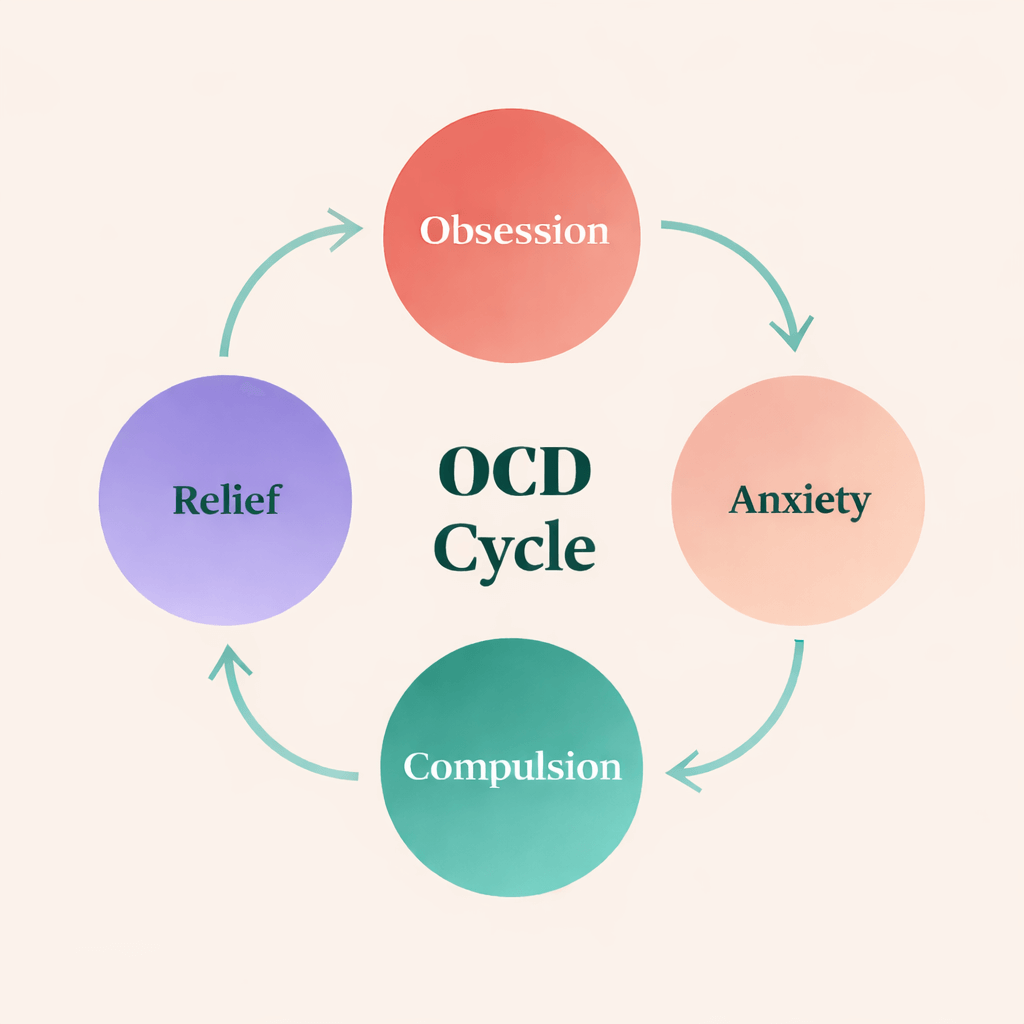
To understand why exposure therapy works, it’s important to understand the OCD cycle. The cycle starts with an intrusive thought (also called an obsession). The intrusive thought might be triggered by something in the environment, or the thought itself might be the trigger. The obsession leads to anxiety, guilt, or discomfort. People with OCD then engage in a behavior that is meant to reduce their anxiety or prevent a feared outcome. That behavior reduces their anxiety in the moment.
However, instead of resolving the issue, the compulsion and temporary relief actually feed the OCD and increase obsessions and anxiety in the long-term. For example, someone with scrupulous OCD might have an intrusive thought about the devil. They may then feel anxious and be concerned that they have accidentally asked a demon to possess them. In order to try to prevent this, they may say a prayer to protect themselves from the devil. This makes them feel better in the moment but increases anxiety and the strength of their obsessions in the long-term.
How Do Compulsions Feed OCD?
There are a few reasons why compulsions feed OCD:
Positive Outcomes
We are more likely to engage in a behavior if it leads to a positive outcome or reward. Think of what happens when you take a pain pill. If I have a headache and I go to the cabinet and take an ibuprofen, soon my pain will decrease or go away. This is going to make it more likely that I will take an ibuprofen in the future because I know that last time, there was a positive result. The same thing happens with compulsions. If I engage in a compulsion and my anxiety decreases in the moment, I’m going to be more likely to engage in a compulsion the next time.
Actions Influence Thoughts
Another reason compulsions feed OCD has to do with how our brains think about danger. Compulsions teach the brain that the triggers are dangerous. The way we act can shape what we believe. After all, if this doorknob is not dangerous, then why did I avoid touching it? To illustrate this further, imagine I put two dogs in front of you. One dog has a muzzle, and the other does not. Which dog are you going to be more afraid of? Probably the dog with the muzzle, because we don’t tend to put muzzles on a dog that doesn’t bite. By putting additional safety measures in place, we are communicating to ourselves that the trigger is something to be afraid of.
Prevent New Learning
Engaging in compulsions prevents us from learning new information. If I keep a muzzle on a dog forever, I will never find out if the dog actually bites. I will always be able to attribute my safety to the muzzle rather than to the dog being safe on its own. Compulsions and avoidance also teach us that we can’t handle anxiety and uncertainty, making them more difficult to tolerate.
What is the Goal of ERP for OCD?
The main idea of exposure therapy for OCD is simple: do the thing you are afraid of, keep doing it, and over time, it will get easier. There are two main components of ERP: exposure and response prevention. Both are crucial for the treatment to work. Exposure involves intentionally bringing on anxiety by facing feared thoughts, situations, or sensations. Response prevention means resisting any compulsions or avoidance in response to that anxiety, cutting off the OCD cycle. Instead of trying to push away anxiety and intrusive thoughts, clients learn to tolerate and welcome them in. Both components are done on purpose in a structured way to test out our fears.
The goal of ERP at Leap Counseling is not necessarily to reduce anxiety or to encounter a trigger without discomfort. Instead, exposures are designed to target a core fear (such as fear of dying or of being a bad person) and to increase overall tolerance of anxiety and uncertainty. Because of this, the specific content of the obsession matters much less than the process. OCD themes or content can change over time, but the underlying demand for absolute certainty and safety is the same.
Final Thoughts From an Online OCD Therapist in Wauwatosa, WI
As an OCD therapist, I like to think of ERP like getting into a cold pool. If you keep one foot in and jump out, the water will always feel freezing. But if you get all the way in and stay in, your body gradually adjusts, and it doesn’t feel as cold. The actual temperature of the water hasn’t changed, but your experience of it has. This is why the goals of ERP are the opposite of the goals of OCD. OCD’s goal is to get rid of anxiety as quickly as possible, while ERP’s goal is to allow and even welcome anxiety in. OCD requires absolute certainty, while the goal of ERP is accepting that uncertainty is inevitable and accepting it as a part of life. In this way, ERP in online therapy for OCD is about taking a leap of faith into the life you truly want.

Discover the Benefits of ERP During Online OCD Therapy in Wauwatosa, WI
If OCD has you constantly avoiding triggers or relying on rituals just to get through the day, you’re not alone, and you don’t have to stay stuck in that cycle. Online therapy for OCD using Exposure and Response Prevention (ERP) can help you gradually face fears without compulsions, reducing anxiety and restoring a sense of control.
Leap Counseling and Consultation offers specialized ERP-based treatment for OCD through a Wisconsin-based solo therapy practice led by Dr. Johanna Wood. With focused training in OCD and anxiety disorders, Dr. Wood provides personalized, evidence-based care designed to help you respond differently to intrusive thoughts and triggers so OCD no longer dictates your choices. Getting started with online OCD therapy is simple:
Take a leap of faith and schedule a free 15-minute consultation
Meet one-on-one with an experienced online OCD therapist in Wauwatosa
Begin learning how to face triggers and reduce compulsions with guided ERP support
Other Services Leap Counseling Provides Across Wisconsin
Breaking free from compulsions can feel intimidating, especially when anxiety spikes the moment you resist them. Through ERP in online OCD therapy, many people learn how to face triggers safely and gradually, reducing anxiety over time and regaining confidence in their ability to cope without rituals.
While OCD treatment is a core focus of my Wisconsin-based online therapy practice, it isn’t the only therapy service available. I recognize that anxiety often shows up in more than one way. As a licensed online therapist serving Wisconsin and all PSYPACT states, I also work with individuals experiencing Panic Disorder, Agoraphobia, Generalized Anxiety Disorder, Social Anxiety Disorder, and specific Phobias.
Wherever you are in your journey, effective, evidence-based help is available. I invite you to explore my mental health blog to learn more about ERP and anxiety treatment, and when you’re ready, reach out to schedule an appointment and begin moving toward lasting relief and greater freedom.
About the Author
Dr. Johanna Wood is a Wisconsin-based clinical psychologist who specializes in treating OCD using evidence-based approaches, including Exposure and Response Prevention (ERP). In addition to her extensive professional training, Dr. Wood brings a deeply personal understanding of OCD to her work, having experienced intrusive thoughts and the anxiety spiral of relationship OCD herself. Through her own ERP treatment, she learned to face uncertainty directly - viewing each exposure as a “leap of faith” - an experience that now shapes how she helps clients confront triggers without compulsions. She earned her PhD in Clinical Psychology from Northern Illinois University, completed her doctoral internship at Rogers Behavioral Health in the OCD and Anxiety Adult Residential Program, and has supervised clinical staff in residential OCD treatment settings. Dr. Wood is licensed in Wisconsin, holds PSYPACT authorization, and is actively involved with the International OCD Foundation, including national education efforts on scrupulosity OCD, bringing both clinical expertise and lived insight to her ERP-based OCD therapy practice.
